A rebate advertised on a contractor’s website may no longer be available when you’re ready to replace your system. As of October 2026, the main statewide programs behind San Diego heat pump rebates have fully reserved their single-family funding.
You can still check utility assistance, financing options, and existing reservations, but your budget should use confirmed funding. Start with the official program status, then verify your home’s eligibility and the installer’s paperwork before signing.
Key Takeaways
- TECH Clean California’s single-family heat pump incentives are fully reserved.
- The single-family HEEHRA rebate is fully reserved, and new income-verification applications are closed.
- Federal Section 25C credits don’t apply to equipment placed in service in 2026.
- SDG&E assistance programs have separate requirements, so check them independently.
- Compare complete installation prices before subtracting any approved incentive.
Check the Status of San Diego Heat Pump Rebates
Program names and historical rebate amounts don’t establish availability. For single-family homes, check whether reserve funds remain for HVAC systems and other energy-efficient products, and whether applications are open for your property type.
TECH Clean California: Single-Family Funds Are Reserved
TECH Clean California’s single-family heat pump HVAC and heat pump water heater incentives became fully reserved statewide on November 14, 2025.
The TECH single-family incentive status is the starting point for checking current restrictions. An earlier approved reservation may still matter, but a new project shouldn’t assume access to those funds.
If a contractor advertises a TECH discount, ask for reservation documentation for your particular installation.
HEEHRA: New Applications Are Closed
The HEEHRA rebate program’s single-family funds became fully reserved statewide on February 24, 2026. New single-family income-verification applications are no longer accepted, and unapproved reservation requests are waitlisted.
Historical California heat pump HVAC amounts included up to $8,000 for households below 80% of area median income. Households at 80% to 150% could qualify for up to $4,000.
Those are historical limits, not offers for new applicants. Check the California Energy Commission’s rebate updates for changes to the Inflation Reduction Act programs.
Federal Section 25C: No Credit for 2026 Installations
Federal tax credits no longer include the former Section 25C tax credit for equipment placed in service in 2026. Older estimates often subtract a credit of up to $2,000.
ENERGY STAR’s federal tax credit guidance identifies the 2025 deadline. Ask contractors to remove the expired credit from any 2026 net-price calculation.
Check SDG&E’s Separate Offers
State funding restrictions don’t automatically answer whether you qualify for utility assistance. Check San Diego Gas & Electric programs separately using your service account.
Treat Old Rebate Listings Cautiously
The SDG&E rebate page lists $500 for a heat pump water heater replacing an electric water heater. However, it also reports that Golden State Rebates retail offers have ended.
Treat that amount as a legacy listing until SDG&E confirms an active offer. It also doesn’t establish eligibility for replacing a gas water heater.
Ask about the current application window, qualifying models, purchase method, and deadline. For hybrid water heaters, confirm that the exact model qualifies. Save the written response rather than relying on a search-result snippet or an old promotional page.
If SDG&E confirms a current demand response program, ask how it differs from an equipment rebate.
Check Income-Qualified Energy Savings Assistance
SDG&E’s Whole Home assistance program advertises eligible improvements worth up to $25,000 at no cost. Potential measures include heat pump heating, cooling, and hot-water upgrades.
However, the pilot is limited to 250 customers. Income-qualified households may face additional limits based on home type, energy use, ZIP code, and appliance conditions.
Standard Energy Savings Assistance also lists heat pump water heaters as a possible measure. Neither program guarantees that every eligible household receives that equipment, so request an assessment before arranging a private installation.
Confirm Your Home’s and Equipment’s Eligibility
An open program can still reject a project that misses its requirements. Establish eligibility before treating an incentive as a discount.
Match Your Household and Property Category
Have your service address, utility account, household size, existing equipment type, and property classification ready.
Market-rate incentives generally don’t use the same income qualification as income-targeted assistance. For a HEEHRA rebate or another income-qualified tier, expect additional verification. Area Median Income limits depend on household size.
Single-family and multifamily funding can also follow different rules. A status update for one category doesn’t establish availability for another, so confirm how the program classifies your property.
Verify the Exact Equipment and Contractor
Ask the installer to identify the outdoor unit, indoor unit or air handler, and water heater model numbers, as applicable. Confirm each energy-efficient product meets the program’s requirements.
ENERGY STAR certification alone doesn’t prove rebate eligibility. Programs may require particular efficiency levels, approved equipment combinations, installation conditions, or contractor enrollment.
A contractor’s claim to be a “certified contractor” doesn’t replace checking its California license, TECH enrollment, or the equipment’s eligibility. Also, don’t assume TECH and HEEHRA can fund the same project. Request written confirmation of any permitted combination and applicable project-cost limits.
Get Reservation Proof Before Installation
TECH reservations go through participating contractors, not homeowners submitting project reservations themselves. The HEEHRA rebate historically also required homeowner income verification and a trained, participating contractor.
If an installer calls themselves a certified contractor, verify the specific credential and program enrollment.
Use this sequence as you plan the installation process and check a proposed incentive:
- Open the official program page and confirm it accepts your project category.
- Ask the installer to confirm enrollment and eligibility for the exact equipment quoted.
- Request the reservation approval, amount, expiration date, and installation deadline when pre-approval is required.
- Put application duties, payment timing, and responsibility for a denied rebate into the contract.
An unapproved waitlisted request has no confirmed rebate value in your installation budget.
If you already have a reservation, check whether changing contractors or equipment affects it. Approval for one proposed system may not transfer automatically to a different installation.
Ask which completion documents the program requires. These may include invoices, equipment information, installation photos, and permit records. Keep copies yourself, even when the contractor handles submission.
Also clarify whether assistance appears as an invoice discount or arrives later. That affects how much cash you need when the installer finishes.
Price the Installation, Including Electrical Work
Rebate eligibility and installation feasibility are different questions. A qualifying model can still require electrical or ductwork changes that increase the project price.
Check Panel Capacity and Water Heater Space
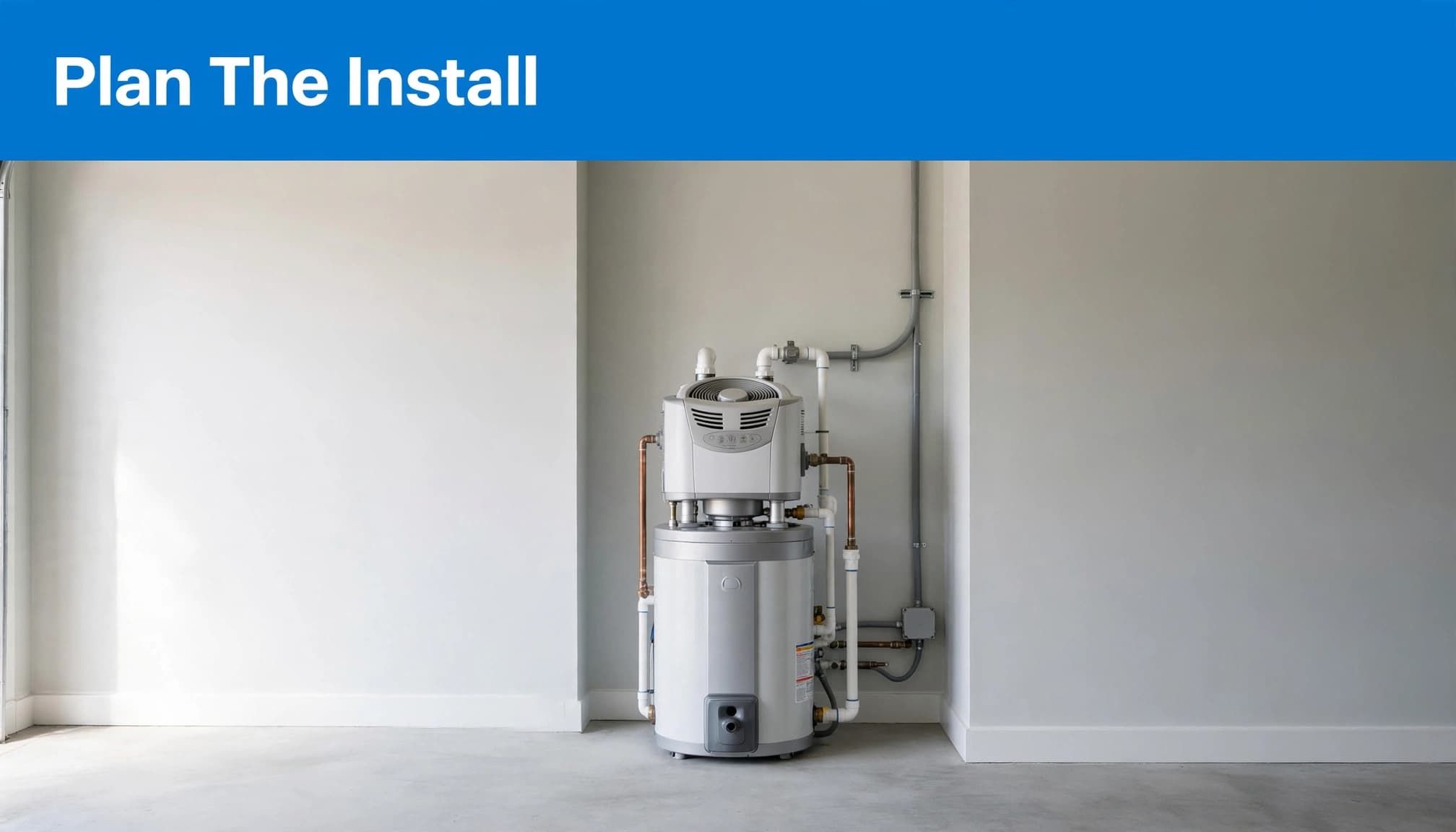
Some older San Diego homes have 100-amp service, but that doesn’t automatically require an electrical panel upgrade. Have the contractor evaluate capacity during the site visit.
Ask whether the installer is a certified contractor, then verify licensing and program enrollment separately.
Many heat pump water heaters need a dedicated 240-volt circuit. Some are marketed as hybrid water heaters, so confirm the selected model’s electrical specifications.
These appliances draw warmth from surrounding air and need suitable airflow, condensate drainage, and operating temperatures. Check the manufacturer’s instructions for room volume and clearance requirements. A small enclosed closet may need modifications or a different installation arrangement.
Check Airflow, Sizing, and Permit Costs
Electric heat pumps can provide both heating and air conditioning, but existing furnace ductwork isn’t automatically suitable.
Ask for heating and cooling load calculations, plus an evaluation of duct sizing and static pressure. Some systems need more airflow than the existing ducts can deliver. For homes where ductwork changes aren’t practical, a ductless mini split may be an alternative.
For coastal properties, discuss outdoor-unit placement and corrosion protection. Higher-elevation homes also need sizing that accounts for colder winter conditions.
The quote should include electrical work, permits, required duct testing, applicable Title 24 documentation, equipment disposal, and startup testing. Otherwise, apparently similar prices may cover different amounts of work.
Compare Costs Without an Unapproved Rebate
Request the full installed price first. Compare confirmed incentives separately across every proposal, and don’t treat unavailable federal tax credits as a price reduction.
Compare Installation and Operating Costs
Look beyond the equipment price. Compare energy-efficient products on a like-for-like basis, including electrical scope, duct repairs, warranty terms, and equipment registration.
Ask whether the installer is a certified contractor, and verify what that certification means.
Switching from gas heating usually increases electricity consumption and reduces gas use. Your total bill depends on actual usage, equipment performance, and your SDG&E time-of-use rate plan.
Ask installers to use your recent utility bills when discussing savings. General efficiency claims can’t predict your household’s operating cost.
Check any demand response program separately. Don’t count it as a guaranteed rebate or savings source.
For water heating, ENERGY STAR estimates certified heat pump models use about 70% less energy than standard electric water heaters. That comparison doesn’t predict savings against gas equipment or account for installation costs.
Evaluate Financing as a Separate Purchase Decision
GoGreen Home energy financing connects California residents with participating lenders and contractors for eligible upgrades.
A GoGreen promotion advertises 0% APR financing for terms up to 10 years. However, verify current lender participation, eligibility, and terms before budgeting around that offer.
Financing spreads payments; it doesn’t automatically reduce the installation price. Compare APR, fees, repayment length, and total payments with other financing options.
Manufacturer promotions may also help, but request the cash price alongside the financed price. A lower monthly payment can still produce a higher total cost.
Decide Whether to Replace Now or Wait
Waiting makes sense only if your existing equipment remains safe and dependable. Without a confirmed reopening date, you can’t rely on a future rebate when scheduling a replacement.
If both your gas furnace and AC are aging, compare a heat pump with separate replacement options. If the problem is limited, an AC repair assessment may offer a lower-cost way to keep functioning equipment.
Through San Diego County heat pump installation, you can compare proposals from up to three licensed, pre-screened local professionals. Before hiring a certified contractor, verify their license and any required program participation directly. Request identical scope and separate gross prices from approved incentives so the comparison stays fair.
Frequently Asked Questions
Can I Apply for a TECH Rebate Myself?
Homeowners don’t submit TECH project reservations directly. Participating contractors handle reservations and program paperwork. A contractor’s license alone doesn’t establish enrollment, so check both credentials before agreeing to an incentive-dependent installation.
Does a HEEHRA rebate Waitlist Guarantee Payment?
A waitlisted request hasn’t received approved funding. Payment depends on program action and available funds, and new single-family income-verification applications are closed. If your earlier request is waitlisted, ask the program or participating contractor to verify its current status and next steps.
Will a Heat Pump Lower My SDG&E Bill?
It depends on the system you’re replacing, household demand, installation quality, and electricity and gas rates. Heat pumps use electricity efficiently, but efficiency alone doesn’t guarantee a lower combined bill. Request an estimate based on your actual usage and proposed equipment.
Make the Decision With Confirmed Numbers
San Diego heat pump rebates require more than finding an advertised amount. Official availability, project eligibility, and written approval determine whether funding belongs in your budget.
Compare complete installation costs and realistic operating expenses before signing. A well-documented proposal lets you choose confidently without depending on a rebate that hasn’t been approved.