For homeowners comparing SEER2 ratings Orange County contractors list in proposals, the right choice depends on cooling demand, installation quality, and system price.
Coastal homes and inland properties can have different cooling needs, even with similar floor plans. Start by understanding the rating, then compare equipment against your home’s actual requirements.
Key Takeaways
- SEER2 measures seasonal cooling efficiency, not cooling capacity or guaranteed electricity savings.
- Orange County follows Southwest federal standards, including capacity-dependent SEER2 minimums and separate EER2 requirements.
- Higher efficiency generally saves more money where cooling demand is greater.
- Proper sizing, compatible components, and sound ductwork help turn rated efficiency into real performance.
What SEER2 Measures on an AC System
The number describes seasonal efficiency
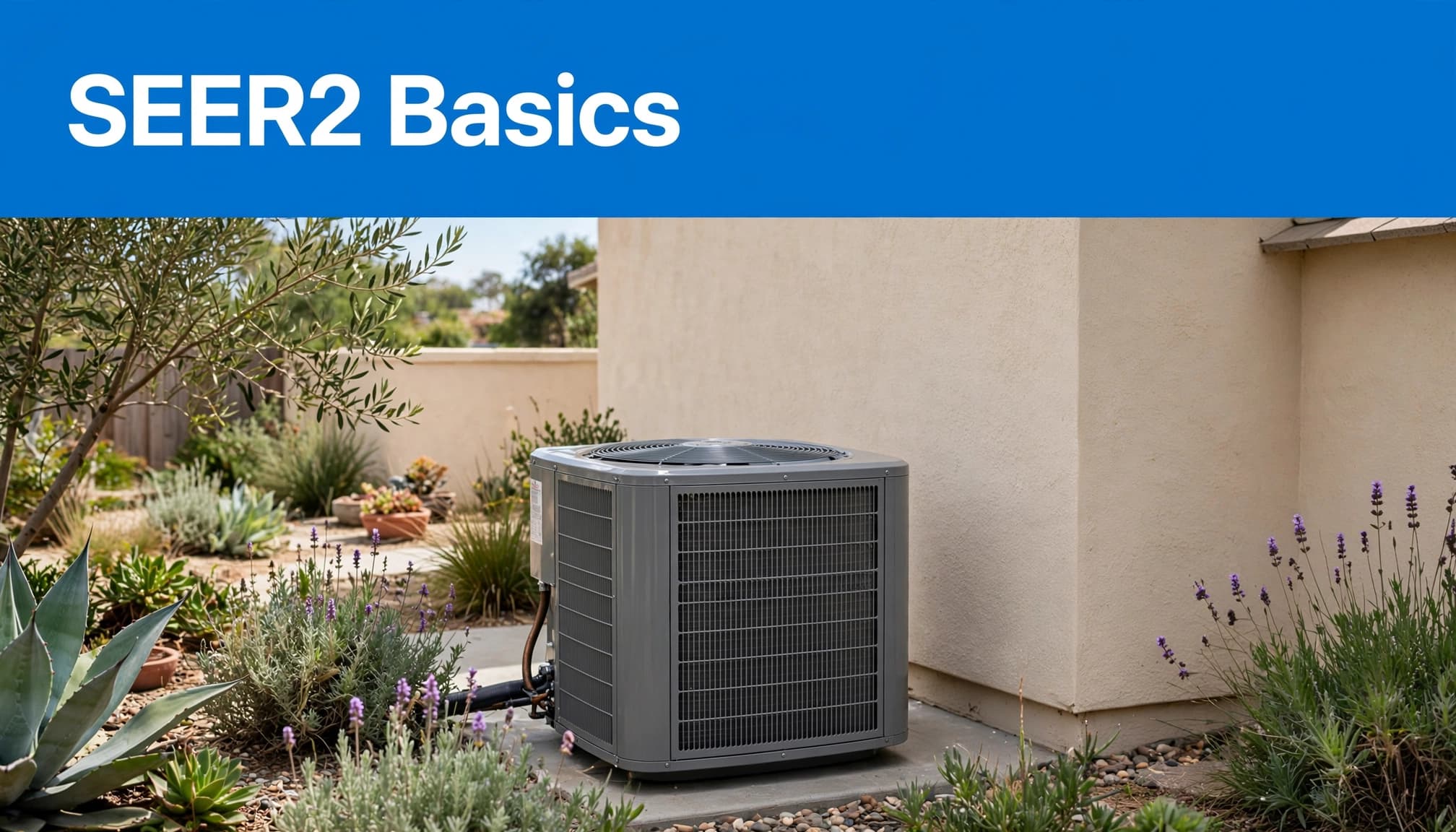
SEER2 stands for seasonal energy efficiency ratio 2. It compares cooling delivered over a standardized season with the electricity consumed.
A higher rating means the tested system delivers more cooling per unit of electricity. However, it doesn’t indicate how much cooling capacity your home needs. Capacity is measured in British thermal units per hour, or Btu/h; one ton equals 12,000 Btu/h.
The rating applies to a matched air conditioning system combination, not just the outdoor unit. Ask for the AHRI certificate identifying the proposed condenser, indoor coil, and applicable furnace or air handler.
Why SEER2 differs from the older SEER rating
The updated M1 testing procedure took effect on January 1, 2023. For typical ducted systems, testing uses 0.5 inches of water column external static pressure to better account for airflow resistance.
That tougher test often produces a lower number than the older procedure for comparable equipment. However, there’s no universal conversion factor for every model.
The International Code Council’s SEER2 and EER2 requirements explain the standards change. Compare certified SEER2 ratings directly rather than converting an old sales brochure.
Minimum SEER2 Ratings in Orange County
California is in the federal Southwest region, where federal minimum efficiency standards apply. For a residential installation of a split-system air conditioner, the minimum depends on rated cooling capacity.
These are the applicable SEER2 thresholds.
| Split-system AC capacity | Minimum SEER2 |
|---|---|
| Below 45,000 Btu/h | 14.3 |
| 45,000 Btu/h or greater | 13.8 |
A typical three-ton system has 36,000 Btu/h of nominal capacity, placing it below the threshold. However, contractors must verify the certified combination rather than rely on nominal tonnage alone.
The Southwest efficiency standards also require EER2 compliance. EER2 is the energy efficiency ratio measured at a specified operating condition, rather than across a season. Its minimum varies with capacity and efficiency category.
These figures don’t cover every equipment type. Packaged systems and heat pumps have separate requirements.
Meeting the minimum makes an installation compliant, but doesn’t show whether higher-rated, energy-efficient units will recover their higher purchase price.
Local Climate and Sizing Shape Comfort
Coastal and inland homes need different calculations
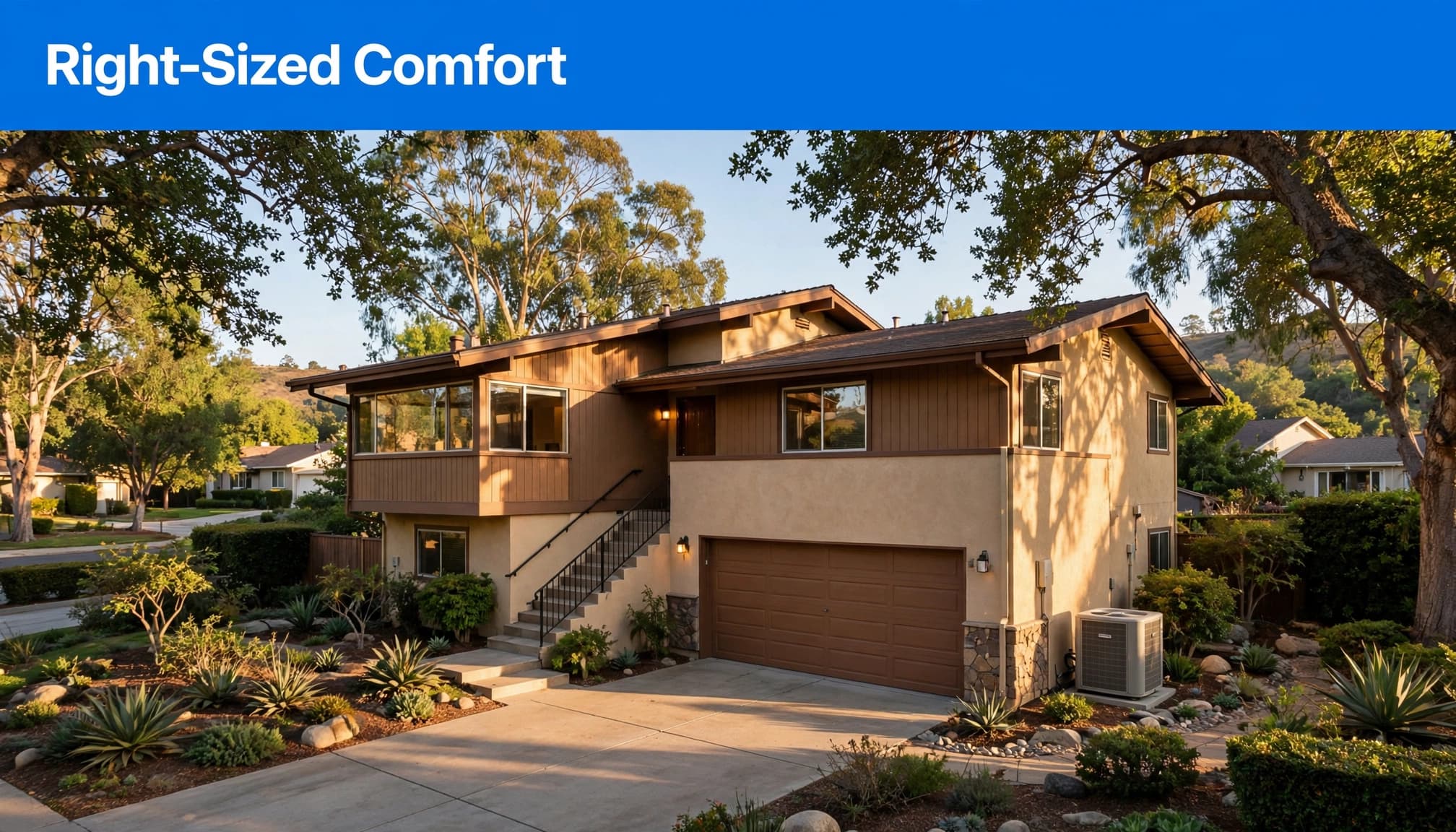
Newport Beach and Huntington Beach often benefit from ocean cooling. In contrast, Yorba Linda and Anaheim Hills generally face greater inland heat exposure.
Because operating hours affect savings, a premium efficiency upgrade may take longer to pay back near the coast. Meanwhile, coastal homeowners should ask about salt-air corrosion protection and its maintenance requirements.
Your home’s details still matter. West-facing windows, attic insulation, shading, and air leakage can change the cooling load substantially. A sunny coastal home may need more cooling than its shaded neighbor.
Proper sizing comes before equipment selection
Request a Manual J load calculation using local design conditions, your home’s construction, and ductwork design. Square footage alone isn’t enough.
An oversized AC can satisfy the thermostat quickly and shut off before removing enough moisture. An undersized unit may struggle to maintain temperature during design heat conditions.
Also, long operating cycles don’t automatically mean a system is undersized. Correctly selected variable-speed equipment often runs longer at reduced output.
When comparing Orange County air conditioning services, ask each installer to explain the load calculation, proposed capacity, and duct airflow requirements. Installation quality also affects real-world comfort and performance, so discuss these details before comparing brands.
Estimating Annual Cooling Costs and Payback
A three-ton example with clear assumptions
A useful estimate needs an electricity price and an annual cooling load. SEER2 indicates the power consumption needed to deliver that cooling, but it can’t predict your bill.
The table assumes a three-ton system delivering 36 million Btu annually, equivalent to 1,000 full-load hours. It uses $0.345/kWh as a benchmark, not a guaranteed utility rate.
| SEER2 | Estimated annual electricity | Estimated cooling cost |
|---|---|---|
| 14.3 | 2,517 kWh | $869 |
| 16 | 2,250 kWh | $776 |
| 18 | 2,000 kWh | $690 |
| 20 | 1,800 kWh | $621 |
Under these assumptions, the modeled energy savings from 18 SEER2 are about $179 annually compared with 14.3 SEER2.
The calculation divides annual cooling output by SEER2, converts watt-hours to kilowatt-hours, then multiplies by the electricity price. Actual results depend on weather, installation, usage, and operating conditions.
Runtime changes the value of an upgrade
At half the annual cooling load, savings between 14.3 and 18 SEER2 fall to about $90. At 1,500 equivalent full-load operating hours, they rise to approximately $268.
At the middle assumption, every $1,000 of added installed cost takes about 5.6 years to recover through electricity savings alone.
However, Southern California Edison’s time-of-use rate plans charge different usage prices across periods. Use rates applicable when your AC operates; don’t include fixed monthly charges as avoidable cooling costs.
Compare lifetime costs, but keep comfort benefits separate from the energy-payback calculation.
Higher Efficiency Can Improve Comfort, Too
Compressor control matters beyond the rating
Single-stage systems operate at one cooling output. Two-stage equipment provides two capacity levels, while a variable-speed compressor adjusts output across a broader range.
Longer, lower-output cycles can reduce temperature swings and improve moisture removal when the controls and airflow settings support it. This can improve thermal comfort and reduce operating noise.
However, SEER2 doesn’t certify sound levels, guarantee humidity control, or measure indoor air quality. Compare published sound data and ask how the proposed equipment handles moisture during mild coastal weather.
Also, don’t treat 20 SEER2 as a universal target. Moving from 18 to 20 represents a smaller energy reduction than moving from 14.3 to 18.
Choose the system type that fits the house
Central air conditioning can make sense when existing ducts are correctly sized and in good condition. For homes without ducts, a ductless mini-split deserves a separate quote.
If your furnace also needs replacement, compare heat pump systems that provide both heating and cooling. Review heating efficiency separately because SEER2 measures cooling.
You can compare Orange County heat pump options alongside conventional AC proposals. Keep the project scope consistent so electrical work or duct changes don’t distort the price comparison.
California’s 2026 Rules Affect Installation Scope
Duct requirements depend on the project
California’s 2025 Building Energy Efficiency Standards became effective January 1, 2026.
For applicable replacements connected to existing ducts, state guidance provides compliance paths of 10% total leakage or 7% leakage to outside. If neither is achievable, accessible leaks must be sealed and verified through the prescribed process.
An entirely new or complete replacement duct system has a 5% leakage limit. Therefore, a blanket claim that every replacement requires leakage below 4% is inaccurate.
Ask which requirements apply to your permit and whether the quote includes testing, corrections, and verification.
Refrigerant changes require compatible components
As the refrigerant phase-out continues, many new systems use lower-global-warming-potential refrigerants, including R-32 and R-454B. These are A2L refrigerants and require compatible equipment and applicable safety measures.
Existing R-410A systems can still receive service. The refrigerant transition alone doesn’t require you to replace functioning equipment.
For an HVAC replacement, ask for the exact refrigerant, indoor coil specifications, and line-set plan. Contractors should explain recovery of the old refrigerant and any required electrical or safety work.
Avoid assuming every existing line set must be replaced. Its suitability depends on the new equipment manufacturer’s requirements and its condition.
Compare Complete HVAC Quotes, Not Sticker Prices
Match equipment and installation scope
Carrier, Trane, and American Standard offer equipment across different efficiency tiers. For a split-system air conditioner, compare exact models and certified combinations in complete proposals, not by brand reputation alone.
Each proposal should identify capacity, SEER2, EER2, thermostat requirements, duct corrections, permits, refrigerant work, and commissioning details that demonstrate installation quality. For HVAC replacement, compare parts and labor warranties separately.
A condenser’s advertised efficiency doesn’t establish the installed system’s rating. The matched indoor equipment must support the quoted performance.
Ask for startup documentation showing airflow and refrigerant-charge verification. If bills have risen, investigate duct leakage, insulation, rate changes, and equipment condition before assuming replacement is the answer.
Keep incentives separate from the contract price
The IRS confirms that the Energy Efficient Home Improvement Credit isn’t available for property placed in service after December 31, 2025. Don’t deduct the former Section 25C credit from a 2026 installation estimate.
Utility rebates and manufacturer offers can change. Confirm eligibility for the exact equipment, any pre-approval requirement, and who submits the paperwork.
Through 3HVACQuotes, homeowners can compare up to three licensed, insured, pre-screened professionals for AC replacement in Orange County. Request itemized prices before incentives so the proposals remain comparable.
Frequently Asked Questions
Does a higher SEER2 system cool faster?
No. Cooling capacity determines available output, while SEER2 measures seasonal efficiency. Two properly matched three-ton systems can have different ratings without different nominal capacities. Buying extra capacity to cool faster can create short cycling and moisture problems.
Should I repair an older AC instead?
A repair can make sense when the problem is isolated and the rest of the system remains sound. Compare the repair cost, equipment condition, and replacement scope. An Orange County AC repair assessment can help distinguish a failed component from broader problems.
Is 18 SEER2 worth buying near the coast?
It depends on the installed price premium, annual cooling demand, and comfort priorities. Lower runtime generally lengthens energy payback. However, quieter operation and better capacity control may still justify the upgrade for your household. Compare those benefits separately from projected savings.
Choose Efficiency That Fits Your Home
SEER2 helps you compare cooling efficiency, but proper sizing and installation determine how well the equipment performs at home. Orange County’s coastal and inland conditions make a single countywide recommendation unreliable.
Start with a load calculation and complete, matched-system quotes. Then compare the efficiency premium against realistic operating costs and the comfort improvements you value.